
General Assembly Brings Together Researchers from the Second Phase of CDRterra
© Karin Adolph
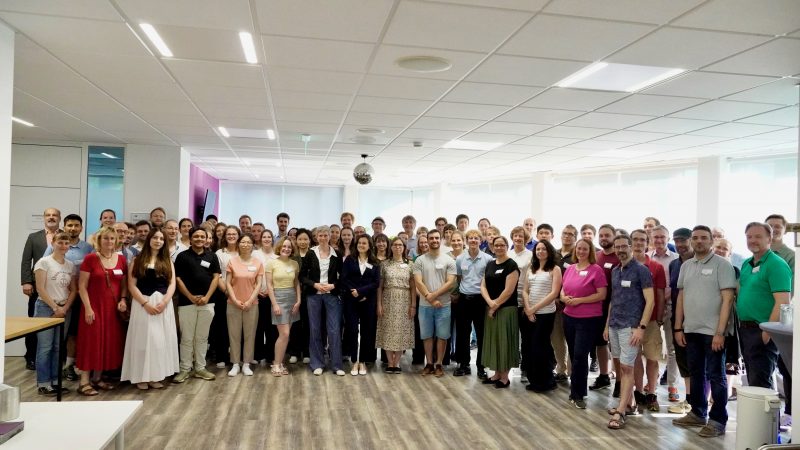
From 24 to 26 June, approximately 120 researchers from the 17 collaborative projects funded under the second phase of CDRterra will meet for the first time at the programme’s General Assembly in Kassel. Funded by the German Federal Ministry of Research, Technology and Space (BMFTR) with around €33 million, the research programme brings together 56 institutions from across Germany. The General Assembly marks the launch of programme-wide collaboration: project consortia will present their research, align common priorities, and develop new cross-project partnerships.
New Research Priorities in the Second Funding Phase
Building on the results of the first funding phase, the second phase deepens and advances selected research areas. While Phase 1 explored a broad range of Carbon Dioxide Removal (CDR) approaches, assessing their potentials, limitations, and interactions and developing scientific evaluation frameworks, the new collaborative projects now focus on further developing these approaches and examining the conditions under which they could realistically be deployed in the future.
Four overarching research priorities will be at the centre of the General Assembly: advancing applications of Bioenergy with Carbon Capture and Storage (BECCS), including new concepts for the use of biogenic residues and cascading biomass utilisation; developing new applications of Direct Air Carbon Capture and Storage (DACCS); further improving land-based CDR approaches; and investigating the policy and regulatory frameworks required to support a potential scale-up of carbon dioxide removal.
Building the Scientific Foundation for Scaling Up CDR
“To achieve net-zero greenhouse gas emissions, we must reduce emissions as rapidly and extensively as possible while significantly expanding carbon dioxide removal. For this scale-up to succeed, we need robust scientific evidence on the contribution different approaches can make and the conditions under which they can be deployed effectively. These are precisely the questions at the heart of CDRterra’s second funding phase,” says Prof. Dr. Julia Pongratz, spokesperson for CDRterra and Chair of Physical Geography and Land Use Systems at Ludwig Maximilian University of Munich (LMU).
“In the first funding phase, we established an important foundation through the development of a common assessment framework and a future scenario for carbon dioxide removal in Germany. We are now extending this approach to additional application areas and integrating it more closely with the work of the research mission CDRmare. This will enable us to assess land- and ocean-based CDR approaches on a common basis in the future,” says Dr. Felix Havermann, Scientific Coordinator of CDRterra at LMU.
Advancing Research Through Collaboration
In addition to scientific workshops, the General Assembly will provide opportunities for exchange with the partner programme CDRmare and with representatives of the Federal Ministry of Research, Technology and Space on current developments in research and innovation policy related to carbon dioxide removal. The Early Career Scientists Forum will also present its activities and support networking among early-career researchers across the CDRterra community.