

CO₂ Removal During Overshoot
© Ève Barlier
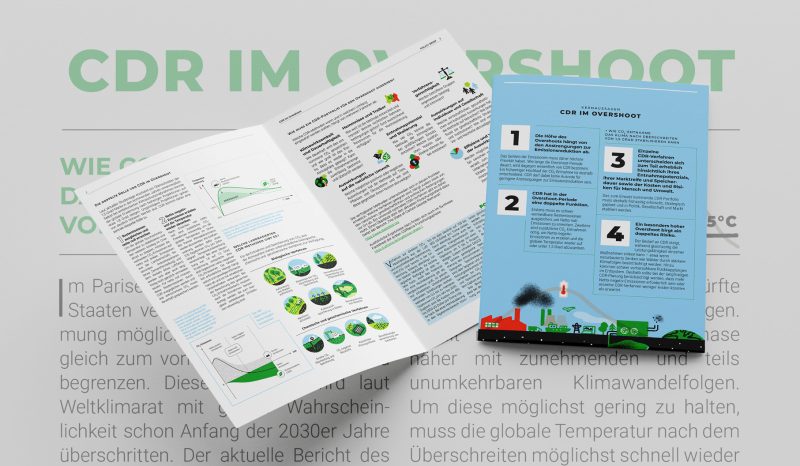
New CDRterra Policy Brief: CDR in Overshoot
The policy brief “CDR in Overshoot—How CO₂ Removal Can Stabilize the Climate After Exceeding 1.5 Degrees” explains the dual role of CDR, highlights the potential and limitations of various methods, and examines the uncertainties involved in long-term planning.
The key message: Emissions reductions must be the top priority. At the same time, an early ramp-up of CO₂ removal is crucial to bringing global temperatures back down in the long term.
The policy brief was developed by researchers from the Öko-Institut, the Potsdam Institute for Climate Impact Research (PIK), the German Institute for International and Security Affairs (SWP), and Ludwig Maximilian University of Munich (LMU).CO₂ Removal Plays a Dual Role During the Overshoot
How much the global temperature rises above the 1.5-degree threshold depends primarily on how quickly greenhouse gas emissions decline. How long the so-called overshoot phase lasts, on the other hand, is largely determined by CO₂ removal (Carbon Dioxide Removal, CDR).
CDR serves two purposes: First, it must offset residual emissions that are difficult to avoid in order to achieve net-zero emissions and halt further temperature rise. Additional CO₂ removal then enables net-negative emissions to bring the temperature back down.
An estimate illustrates the quantities that might be required for this: approximately 220 billion metric tons of CO₂ are estimated per tenth of a degree of temperature reduction. A reduction from 1.8 to 1.5 degrees would therefore correspond to around 660 billion metric tons of net-negative emissions. The actual requirement depends on the specific climate scenario and is subject to considerable uncertainty. To determine the total CO₂ removal requirement, removals needed to offset remaining emissions must also be taken into account.
More Warming, Less CO₂ Removal?
A large overshoot poses a twofold risk: The need for CO₂ removal increases, while at the same time the effectiveness of individual methods may decline.
Biological methods are particularly affected. More frequent droughts, heat waves, and pest infestations, for example, can damage forests. As a result, they absorb less CO₂ and may release carbon that has already been stored. Carbon storage in soils can also be impaired by changing climate conditions.
Added to this are hard-to-predict feedback loops in the Earth system that can further exacerbate climate change.
Why an Early-Stage CDR Portfolio Is Crucial
CO₂ removal methods vary significantly in terms of their potential, costs, technological maturity, storage duration, and risks. There is no single method that is universally optimal.
This policy brief therefore explains why different methods must be researched, further developed, and coordinated at an early stage. Methods already available, such as reforestation, could make a significant contribution initially. Technically more complex methods, such as direct air capture and carbon storage (DACCS), could gain importance later on.
However, it is not certain that biological methods will maintain their effectiveness as climate impacts intensify. Therefore, additional CO₂ removal capacities should also be taken into account in long-term planning.