

How the EU Certifies Permanent CO₂ Removal
© Eve Barlier
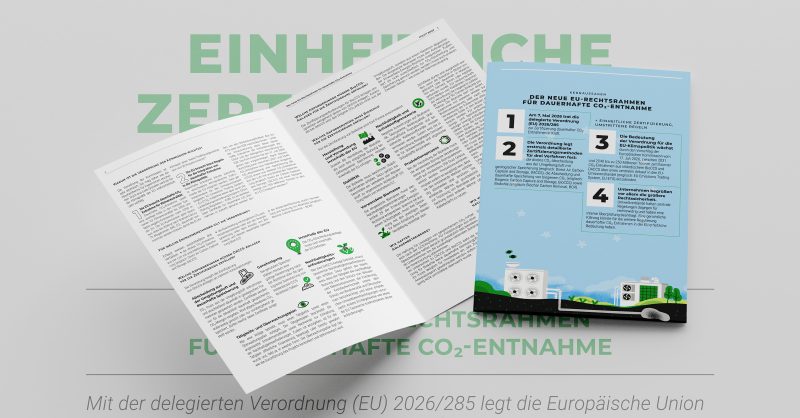
What requirements must permanent CO₂ removal processes meet to receive an EU certificate? And what do the new rules mean for European climate policy? A new CDRSynTra Policy Brief explains the European certification framework, highlights unresolved legal issues, and examines potential implications for the EU Emissions Trading System.
Uniform Certification Rules for Three Methods for the First Time
Starting in May 2026, detailed certification methods will apply in the EU for the first time to three processes for permanent CO₂ removal: direct air capture and geological storage (DACCS), the capture and storage of biogenic CO₂ (BioCCS), and the production and use of biochar.
The new Delegated Regulation (EU) 2026/285 specifies the European Certification Framework for CO₂ Removal (CRCF). Among other things, it defines how the actual net removal achieved is calculated, which sustainability requirements apply, and how storage must be verified.
What role will CO₂ removal play in the EU Emissions Trading System in the future?
The new standards could also become increasingly important for European climate policy in the future. In July 2026, the European Commission proposed integrating up to 250 million metric tons of certified CO₂ removals from DACCS and BioCCS within the EU into the European Emissions Trading System (EU ETS) between 2031 and 2040 through a central procurement process.
This raises the question of what criteria will be used to recognize CO₂ removals and assess their climate impact.
Unresolved Legal Questions Surrounding Certification
The new rules have prompted mixed reactions. While companies see them as an important step towards greater planning and investment certainty, several environmental organisations have criticised key provisions.
A central concern is whether all relevant emissions and impacts on existing carbon stocks are adequately accounted for in biomass-based removal methods. The requirements for the permanent storage of carbon in biochar are also contested.
Several environmental organisations have therefore requested an internal review of the regulation. Potential legal proceedings could have far-reaching implications for the further development of the European certification framework.
New CDRSynTra Policy Brief Analyses the Developments
The Policy Brief “Uniform Certification, Contested Rules: The New EU Legal Framework for Permanent CO₂ Removal” by Dr Nils Meyer-Ohlendorf (Ecologic Institute) outlines the key certification requirements, explains the different positions and analyses the legal and climate policy implications.
The publication was produced as part of the CDRSynTra2 research consortium, which provides scientific support and synthesis for the research activities conducted under the BMFTR-funded CDRterra research programme.