
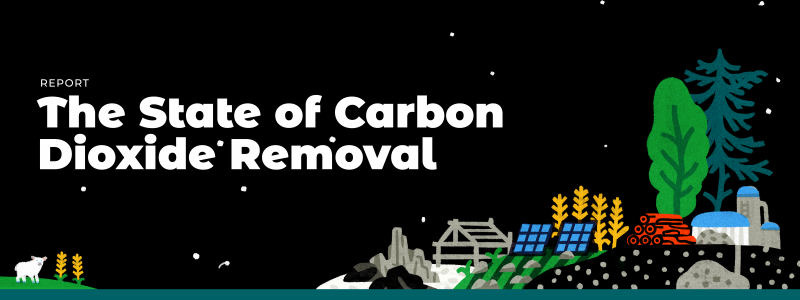
New SoCDR Report: Carbon Dioxide Removal Must Scale Up Significantly Faster
© Ève Barlier
Global climate targets are unlikely to be achieved without a rapid expansion of Carbon Dioxide Removal (CDR). This is the conclusion of the third edition of the international State of Carbon Dioxide Removal (SoCDR) report, to which researchers from the CDRterra consortium also contributed. According to the report, a gap of more than 5 billion tonnes of CO₂ per year is projected by 2050 between current national commitments and pathways consistent with limiting global warming to 1.5°C.
Emissions Reductions Remain Central
The report makes clear that emissions reductions remain the most important climate mitigation measure. The majority of efforts to limit global warming must continue to come from reducing greenhouse gas emissions. At the same time, carbon dioxide removal will be needed to compensate for hard-to-abate emissions and to halt further temperature increases as long as CO₂ emissions continue. As the risk of temporarily exceeding temperature targets increases, CDR also plays an important role in so-called overshoot scenarios.
According to the report, a delay of just ten years in climate action would increase global warming by approximately 0.15°C and further increase the subsequent need for carbon dioxide removal.
Carbon Dioxide Removal Remains Limited Worldwide
Currently, around 2.2 billion tonnes of CO₂ are removed from the atmosphere globally each year, almost exclusively through land-based measures such as afforestation and ecosystem restoration. Emerging technological approaches, including Direct Air Carbon Capture and Storage (DACCS) and Enhanced Weathering, currently account for only around 0.1% of total carbon dioxide removal.
At the same time, research activities, pilot projects, and investments in this field are expanding significantly. According to the report, approximately 3% of global investments in climate technologies are now directed towards carbon dioxide removal.
However, the authors caution against relying on any single approach. “There is a wide range of estimates regarding how much carbon dioxide removal individual CDR methods can deliver. For most methods, the more conservative potential estimates are around 1 billion tonnes of CO₂ per year or less when more robust studies or stricter implementation assumptions are taken into account. Therefore, we cannot rely on a single method to close the CDR gap,” says Sabine Fuss of the Potsdam Institute for Climate Impact Research, co-author of the SoCDR report and researcher within CDRterra.
“A diverse portfolio of CDR methods employing different approaches and tailored to different contexts and geographical conditions is required. This would help maintain flexibility, reduce costs, and minimise risks.”
The Window of Opportunity Until 2030 Is Critical
The report also emphasises that the period leading up to 2030 will be decisive. Emerging CDR approaches must scale up much more rapidly while also demonstrating their ability to provide durable carbon storage and generate additional benefits, for example for soils, ecosystems, or regional value creation.
At the same time, the current CDR system remains fragile. According to the report, only around 20% of the announced capacities for new technological carbon dioxide removal have actually been implemented in recent years.
International Assessment Highlights Opportunities and Limitations
The State of Carbon Dioxide Removal report is an independent global assessment of carbon dioxide removal. Contributors include researchers from the University of Oxford, the Potsdam Institute for Climate Impact Research (PIK), the German Institute for International and Security Affairs (SWP), Ludwig Maximilian University of Munich (LMU Munich), the University of Wisconsin–Madison, and the University of Maryland.
Researchers from the CDRterra consortium also contributed to the current edition. The report synthesises the international state of research on the potentials, risks, costs, and development needs of different carbon dioxide removal approaches and provides a scientific basis for political and societal decision-making regarding the role of CDR.