

CO₂ Removal on the Political Agenda: Discussion in the Bundestag
© Christiane Hamann
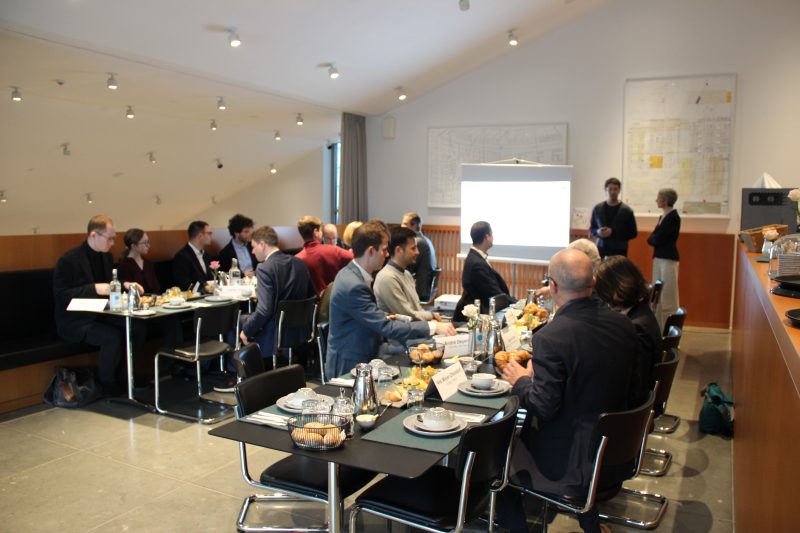
How can global warming be reversed after an overshoot? And what role could the EU Emissions Trading System play in supporting CO₂ removal? These were the key questions discussed by policymakers and researchers at CDRterra’s parliamentary breakfast in the German Bundestag.
Around 25 representatives from parliamentary groups, academia and associations gathered on 6 November 2026 to discuss recent research findings and policy options. The event was hosted under the patronage of Helmut Kleebank, a Member of the German Bundestag (SPD).
Overshoot: How can global temperatures be brought down again?
What are the consequences of temporarily exceeding the 1.5°C threshold? CDRterra researcher Prof. Dr. Sabine Fuss from the Potsdam Institute for Climate Impact Research (PIK) explained the conditions required to achieve a long-term reduction in global temperatures.
This requires global net-negative emissions: more CO₂ must be removed from the atmosphere than is still being emitted. Achieving this depends on deep reductions in greenhouse gas emissions, complemented by additional CO₂ removal.
EU Emissions Trading System: What role could CO₂ removal play in the future?
The second session focused on a key development in European climate policy. In July 2026, the European Commission proposed using the EU Emissions Trading System (EU ETS) to help finance permanent CO₂ removals. From 2031 onwards, revenues from auctioning additional emission allowances would be used to purchase certified removals from bioenergy with carbon capture and storage (BioCCS) and direct air carbon capture and storage (DACCS).
Dr. Nils Meyer-Ohlendorf from the Ecologic Institute, a project partner in CDRterra’s synthesis project CDRSynTra2, presented the proposal and possible approaches to integrating CO₂ removal into the EU ETS. The discussion focused on financing and how to incentivise CO₂ removal without weakening incentives to reduce emissions.
Helmut Kleebank (SPD), Member of the German Bundestag, member of the Committee on the Environment and the Committee on Economic Affairs and Energy, and Deputy Spokesperson for Energy Policy of the SPD parliamentary group, offered a parliamentary perspective on the proposals.
From scientific evidence to political action
The event took place at a time of important climate policy decisions. At EU level, discussions on reforming the Emissions Trading System are ongoing, while Germany is working on the further development of its Long-Term Strategy for Negative Emissions (LEA).
The framework conditions needed to scale up CO₂ removal approaches were also a central topic of the subsequent moderated discussion. Prof. Dr. Julia Pongratz, spokesperson for CDRterra and professor at Ludwig Maximilian University of Munich (LMU), opened and closed the event, highlighting the need for long-term planning and action.
For more information on overshoot, see the new CDRterra Policy Brief CDR in an Overshoot Context. The integration of CO₂ removal into the EU Emissions Trading System is examined in a SWP-Aktuell published by the German Institute for International and Security Affairs (SWP).
More Information here: